How to scale throughput, fan-out, retries, replay, and failure isolation without turning the event backbone into a shared bottleneck
Event-driven systems are often described with a simple diagram:
Producer
↓
Event broker
↓
Consumers
That diagram explains decoupling. It does not explain scale.
At scale, the important questions are different:
– Which events must stay ordered?
– What is the unit of parallelism?
– What happens when one tenant is noisy?
– Can consumers recover faster than producers create work?
– How does replay compete with live traffic?
– Which downstream system becomes the real bottleneck?
– How are retries prevented from multiplying load?
– How is business completion measured across asynchronous boundaries?
A system does not scale merely because it uses Kafka, queues, or a cloud event bus.
The core principle is:
The scaling unit in an event-driven system is not the service. It is the combination of partition, key, consumer capacity, downstream dependency, and recovery policy.
1. SCALE HAS MORE THAN ONE DIMENSION
Teams often reduce scale to events per second.
A production event system must handle at least five dimensions.
Volume
How many events arrive?
Variance
How bursty is the arrival rate?
Fan-out
How many consumers react to each event?
State
How much ordering, history, or per-entity coordination is required?
Recovery
How much retained work may need to be replayed after a failure or defect?
Two systems with the same throughput can have very different architectures.
Example A:
– one million telemetry events per second
– no per-device ordering requirement
– a small payload
– best-effort analytics.
Example B:
– ten thousand financial events per second
– strict per-account order
– several durable consumers
– replay and audit requirements
– external processor dependencies.
The second system may be harder to scale despite lower volume.
2. START WITH THE BUSINESS ORDERING BOUNDARY
Ordering is expensive because it limits parallelism.
The wrong requirement is:
“All events must remain globally ordered.”
The useful requirement is:
“Events for one business entity must remain ordered.”
Typical ordering keys include:
– order ID
– payment ID
– account ID
– customer ID
– device ID
– merchant ID.
Kafka guarantees record order within a topic partition, not across all partitions.[1] That means the partition key becomes part of business correctness.
A key defines:
– what can be processed concurrently;
– what must be serialized;
– where a hot entity can create contention;
– which events can be replayed independently.
Treat the key as an architectural decision, not a broker configuration.
3. PARTITIONS ARE A CONCURRENCY BUDGET
A topic with twelve partitions gives a conventional consumer group at most twelve simultaneously active partition owners.
Adding more consumer instances beyond the partition count does not add processing parallelism for that group.
This creates a practical relationship:
Partition count
→ maximum consumer concurrency
→ possible drain rate
→ recovery time
However, increasing partitions is not free.
It affects:
– metadata
– broker load
– open files
– consumer rebalancing
– producer distribution
– operational complexity.
Current Kafka documentation also warns that increasing partition count can change hash-based key mapping, which can affect ordering guarantees for existing keys if producers begin routing the same key differently after the change.[2]
Therefore, “we can add partitions later” should not be treated as a complete capacity plan.
4. THE KEY ALSO DEFINES FAIRNESS
A technically valid key can still create an unfair system.
Suppose events are keyed by merchant ID.
One very large merchant may dominate one partition. Smaller merchants sharing that partition then experience higher lag even if other partitions remain lightly loaded.
This is a hot-partition problem, but it is also a fairness problem.
The platform must decide:
– should one entity receive strict serialization?
– should high-volume tenants receive isolated partitions or topics?
– can the key be made more granular?
– can ordering be scoped to a sub-entity?
– should traffic be rate-limited before the broker?
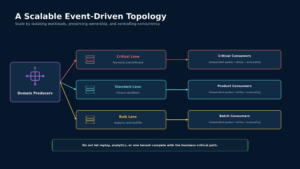
Figure 1. A partition key defines both the ordering boundary and how fairly work is distributed across tenants.
Possible strategies include:
Tenant isolation
Place very large tenants in separate topics, partitions, or consumer pools.
Composite keys
Use merchant ID plus a stable sub-entity when business rules permit parallelism.
Shuffle sharding
Assign each tenant to a small subset of resources rather than one shared global pool.
Quotas
Limit how much producer or consumer capacity one tenant can consume.
Priority classes
Separate high-value or latency-sensitive traffic from bulk work.
The correct solution depends on the business semantics. Random sharding is unsafe when entity order matters.
5. SCALE THE WHOLE PATH, NOT ONLY THE BROKER
Event brokers are optimized for throughput. The system usually fails somewhere else.
Common bottlenecks include:
– relational databases
– search indexes
– third-party APIs
– payment processors
– rate-limited SaaS services
– shared caches
– locks on one business entity
– expensive serialization
– one overloaded partition.
Increasing consumer count can make the failure worse.
Suppose a downstream database can safely process 2,000 writes per second. Increasing consumers until they attempt 10,000 writes per second may produce:
– longer latency
– connection exhaustion
– timeouts
– retries
– duplicate work
– a larger backlog.
This is why event-driven scale must be designed as an end-to-end capacity relationship.
Producer rate ≤ sustainable broker ingestion
Broker retention ≥ time needed for recovery
Consumer drain rate ≤ safe downstream capacity
Recovery drain rate > live arrival rate
The last relationship is critical. If consumers cannot process faster than new work arrives, the backlog can never recover.
6. ISOLATE WORKLOAD CLASSES
Many event backbones mix:
– customer-facing transactions
– notifications
– analytics
– replay
– backfills
– machine-learning features
– reconciliation.
These workloads should not always share the same concurrency, retry, and retention policies.
A scalable topology separates at least three classes.
Critical lane
Examples:
– payment state
– inventory reservation
– fulfilment
– account updates.
Characteristics:
– strict latency target
– bounded retry
– strong observability
– controlled ordering
– protected capacity.
Standard lane
Examples:
– product notifications
– read-model updates
– ordinary workflows
Characteristics:
– moderate latency tolerance
– scalable consumer pools
– limited stale processing
Bulk lane
Examples:
– analytics
– historical backfills
– model features
– replay.
Characteristics:
– throughput-oriented
– lower priority
– schedulable
– aggressively rate-limited.
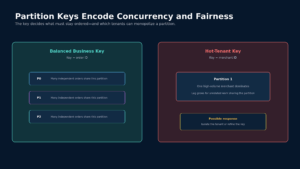
Figure 2. Critical, standard, and bulk workloads need separate quotas, retry policies, and consumer capacity.
This separation prevents replay or analytics traffic from competing with the live business path.
The principle is:
Workloads with different consequences should not inherit the same failure domain by convenience.
7. BACKPRESSURE IS A PRODUCT DECISION
Backpressure means the system communicates that downstream capacity is constrained.
Possible responses include:
– slow producers
– reject low-priority work
– buffer within a defined limit
– degrade optional features
– delay bulk processing
– shed load.
Teams sometimes avoid backpressure because it makes overload visible.
Without backpressure, overload still exists. It appears later as:
– unbounded queue growth
– expired events
– timeouts
– cascading retries
– old business actions executing too late.
Backpressure should be connected to product priority.
Examples:
– preserve payment events
– delay recommendation updates
– drop disposable telemetry
– pause historical replay
– reject non-essential bulk jobs.
The architecture should answer:
Which work is allowed to wait, and which work must never wait behind it?
8. BACKLOG COUNT IS NOT ENOUGH
A queue with one million events may be healthy if consumers process several million per minute.
A queue with one hundred events may be unhealthy if the oldest payment has waited thirty minutes.
Track:
– backlog depth
– oldest event age
– incoming rate
– drain rate
– partition skew
– retry rate
– downstream latency
– estimated recovery time.
Estimated recovery time can be reasoned about as:
backlog size ÷ (drain rate − arrival rate)
This relationship is meaningful only when drain rate exceeds arrival rate.
Amazon’s Builders’ Library emphasizes that queue backlogs can become insurmountable when systems cannot drain accumulated work safely and when recovery traffic overwhelms dependencies.[3]
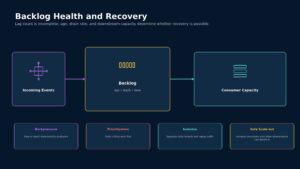
Figure 3. Backlog health depends on age, depth, skew, arrival rate, drain rate, and downstream capacity.
The most useful question is not:
How many messages are waiting?
It is:
Can the system recover before the business value of this work expires?
9. RETRIES CAN AMPLIFY FAILURE
Retries are necessary because transient failures occur.
They are also a load multiplier.
Suppose:
– ten consumers process one event
– each times out
– each retries three times
– the downstream dependency is already overloaded.
The dependency now receives forty attempts instead of ten.
At scale, retries can become the dominant traffic source.
Use:
– bounded retry counts
– exponential backoff
– jitter
– idempotency
– circuit breakers
– retry budgets
– explicit unknown states.
AWS guidance recommends timeouts, backoff, and jitter to prevent correlated retries and make retry behaviour safer.[4][5]
A retry policy must answer:
– which errors are retryable?
– how long is the operation still valuable?
– can the effect be repeated safely?
– which identifier allows status lookup?
– when should the event leave the live lane?
Retrying forever is not resilience. It is deferred failure.
10. IDEMPOTENCY IS THE BUSINESS SAFETY NET
At-least-once delivery means an event may be processed more than once.
The broker cannot prevent every duplicated business effect across:
– a consumer
– a database
– an external API
– a crash
– an offset commit.
Consumers must define an idempotency boundary.
Possible keys include:
– event ID
– business entity plus operation
– entity version
– command ID
– provider operation ID.
Example:
payment-4821:capture:v3
The consumer stores the first completed result and returns it when the same operation appears again.
The important detail is atomicity.
If a consumer:
1. updates business state
2. crashes before recording that the event was processed
the event may repeat the update.
Where possible, the business change and idempotency marker should commit together.
11. DESIGN FOR UNKNOWN OUTCOMES
A timeout does not prove failure.
The downstream system may have:
– never received the request
– received but not completed it
– completed it while the response was lost.
The consumer should represent:
UNKNOWN
rather than forcing:
FAILED
Recovery may require:
– querying by operation ID
– waiting for a webhook
– reconciling with an external report
– manual review.
Unknown outcomes are especially important in payments, fulfilment, and financial workflows.
A scalable system that processes ambiguous state faster is not more correct.
12. EVENT CONTRACTS MUST SURVIVE ORGANIZATIONAL SCALE
As more teams publish and consume events, the contract becomes an organizational interface.
A durable event contract should define:
– event name
– business meaning
– owner
– key
– schema version
– ordering expectation
– delivery semantics
– retention
– sensitive fields
– compatibility policy.
Prefer events such as:
Order Confirmed
Payment Captured
Inventory Reserved
Avoid events such as:
Order Row Updated
Status Changed to 7
Database Record Modified
Business events survive implementation changes more effectively.
Schema evolution should be additive where possible:
– add optional fields
– preserve old meaning
– provide migration windows
– test consumer compatibility
The event backbone is not a database-change broadcast system. It is a shared business contract surface.
13. REPLAY IS A SEPARATE WORKLOAD CLASS
Replay is one of the strongest reasons to use durable event streams.
It supports:
– rebuilding read models
– correcting consumer defects
– onboarding new consumers
– recomputing analytics
– incident reconstruction
Replay also creates risk.
A replay can:
– overload downstream systems
– resend customer notifications
– repeat irreversible business effects
– consume critical broker bandwidth
– expose old schema assumptions
– create duplicate writes.
Treat replay as a controlled operational product.
A replay request should include:
– topic and partition range
– time or offset range
– target consumer
– expected event volume
– downstream capacity
– idempotency assurance
– rate limit
– stop condition
– progress visibility.
Live traffic and replay should rarely share unlimited capacity.
14. PRIORITY MUST EXIST BEFORE THE INCIDENT
Teams often introduce priority during an outage.
By then, all work may already be mixed in one queue.
Priority can be expressed through:
– separate topics
– separate partitions
– dedicated consumer groups
– weighted queues
– tenant quotas
– scheduled backfills
– admission control.
Do not rely only on priority fields inside one FIFO partition. A low-priority event already ahead of a high-priority event may still block it.
Priority is most effective when reflected in isolation boundaries.
15. DEAD-LETTER QUEUES ARE NOT A RECOVERY STRATEGY
A dead-letter queue is a holding area for work that exhausted normal processing.
It is useful only when the organization also has:
– ownership
– alerting
– retention
– inspection
– correction
– replay
– audit.
Without these, the dead-letter queue becomes a graveyard.
Classify failures before moving work.
Transient technical failure:
Retry with bounded backoff.
Permanent technical failure:
Quarantine and repair.
Business rejection:
Record the outcome; do not retry forever.
Unknown outcome:
Reconcile or query status.
Poison event:
Isolate without blocking unrelated work.
A dead-letter policy should preserve enough context to explain why the event failed and how it can be safely reintroduced.
16. OBSERVE BUSINESS COMPLETION
Broker metrics are necessary:
– produce latency
– fetch latency
– under-replicated partitions
– consumer lag
– rebalance rate
– disk usage.
They do not prove the business workflow works.
Track:
– orders created versus fulfilled
– payments authorized versus captured
– inventory reserved versus released
– events published versus projections updated
– oldest incomplete workflow
– percentage of events requiring manual repair.
Azure’s event-driven architecture guidance highlights the observability challenge created by asynchronous, decoupled components and recommends correlation identifiers across the workflow.[6]
A useful event envelope includes:
– event ID
– correlation ID
– causation ID
– trace ID
– entity ID
– entity version
– occurred time
– published time
– producer.
The goal is to reconstruct one business journey across independent services.
17. AUTOSCALING CONSUMERS CAN BE DANGEROUS
A simple autoscaler watches lag and adds consumers.
This works only when:
– partitions are available
– processing is stateless or safely partitioned
– downstream dependencies have spare capacity
– new consumers do not cause disruptive rebalances
– retry traffic is controlled.
Otherwise, the autoscaler can amplify an outage.
A safer policy considers:
– lag
– event age
– partition count
– processing latency
– downstream saturation
– error rate
– rebalance frequency.
Scale-out should stop when the sink—not the consumer—is the constraint.
18. DESIGN FOR DRAIN, NOT ONLY STEADY STATE
Steady-state capacity answers:
Can the system keep up during normal traffic?
Recovery capacity answers:
Can the system catch up after an outage?
Suppose traffic arrives at 8,000 events per second and consumers process 9,000.
The system has only 1,000 events per second of recovery capacity.
After one hour of complete consumer outage, the backlog is:
28.8 million events.
At a recovery rate of 1,000 per second, catching up takes eight hours, assuming live traffic remains stable and downstream dependencies tolerate continuous peak processing.
This is why capacity planning must include:
– outage duration
– retained backlog
– safe maximum drain rate
– business expiry
– replay competition
A system that can keep up but cannot catch up is not resilient.
19. COMMON SCALING FAILURES
One topic for everything
Unrelated workloads share ordering, retention, and failure policies.
Partition count chosen by guess
The system discovers its concurrency limit only after traffic grows.
Key chosen only for distribution
Business ordering and fairness are ignored.
Consumer autoscaling without sink awareness
More workers overload the downstream dependency.
Infinite retries
Old work consumes all capacity and never reaches a terminal state.
Replay through the live lane
Historical processing delays current transactions.
Global metrics
Healthy averages hide one hot partition or tenant.
DLQ without ownership
Failed work accumulates without repair.
Broker-centric observability
Infrastructure looks healthy while business completion stops.
20. A SCALING DESIGN REVIEW
For every event flow, ask:
Business semantics
– What fact does the event represent?
– Who owns it?
– Is it a command disguised as an event?
Ordering
– Which entity requires order?
– What is the partition key?
– Can one key become hot?
Capacity
– What is the peak arrival rate?
– What is the sustainable drain rate?
– Can the system recover faster than new work arrives?
Isolation
– Which tenants or workloads can harm others?
– Are critical, standard, and bulk lanes separated?
Failure
– Which errors are retryable?
– Is the operation idempotent?
– How are unknown outcomes resolved?
– Who owns dead-letter recovery?
Replay
– Can historical work be rate-limited?
– Can consumers safely repeat side effects?
– How is progress observed?
Observability
– Which metric proves business completion?
– Can one workflow be traced end to end?
FINAL PERSPECTIVE
Event-driven systems scale when they make concurrency, ordering, fairness, and recovery explicit.
The broker is only the middle.
Real scalability depends on:
– business keys
– partition strategy
– consumer design
– downstream capacity
– workload isolation
– retry discipline
– replay controls
– business observability.
The enduring principle is:
RESEARCH BASIS
[1] Apache Kafka, “Introduction.”
https://kafka.apache.org/documentation/
[2] Apache Kafka, “Basic Kafka Operations.”
https://kafka.apache.org/43/operations/basic-kafka-operations/
[3] Amazon Builders’ Library, “Avoiding Insurmountable Queue Backlogs.”
https://aws.amazon.com/builders-library/avoiding-insurmountable-queue-backlogs/
[4] Amazon Builders’ Library, “Timeouts, Retries, and Backoff with Jitter.”
https://aws.amazon.com/builders-library/timeouts-retries-and-backoff-with-jitter/
[5] Amazon Builders’ Library, “Making Retries Safe with Idempotent APIs.”
https://aws.amazon.com/builders-library/making-retries-safe-with-idempotent-APIs/
[6] Microsoft Azure Architecture Center, “Event-Driven Architecture Style.”
https://learn.microsoft.com/en-us/azure/architecture/guide/architecture-styles/event-driven